Scoring the Weight-Loss Peptides: A Methodology, Not a Recommendation

Every comparison chart on the internet treats “weight-loss peptides” like a single product category with different flavors. Semaglutide, tirzepatide, retatrutide, AOD-9604, 5-Amino-1MQ, MOTS-c, all lined up in a row as if the only real variable were personal preference. This piece exists because that framing does not survive contact with the primary literature. Two axes matter here, not one: how strong is the human evidence behind the molecule, and how accountable is the channel you get it through. Score a compound high on the first axis and buy it through a channel that scores zero on the second, and the good evidence stops protecting you.
The method below is simple and deliberately unglamorous: read the trials, grade the evidence tier for each compound, then separately grade the sourcing options against a five-point checklist. The two scores get combined at the end, and the combination is the actual finding here, not either score alone.
The scoring rubric
Each compound was graded on one question: does published human data show it produces weight loss, and how strong is that data?
- Grade A , large, randomized, placebo-controlled human trials with a clear primary endpoint
- Grade B , human data exists but is early-phase, small, or shows safety without efficacy
- Grade F , no controlled human weight-loss data, evidence stops at animal or observational studies
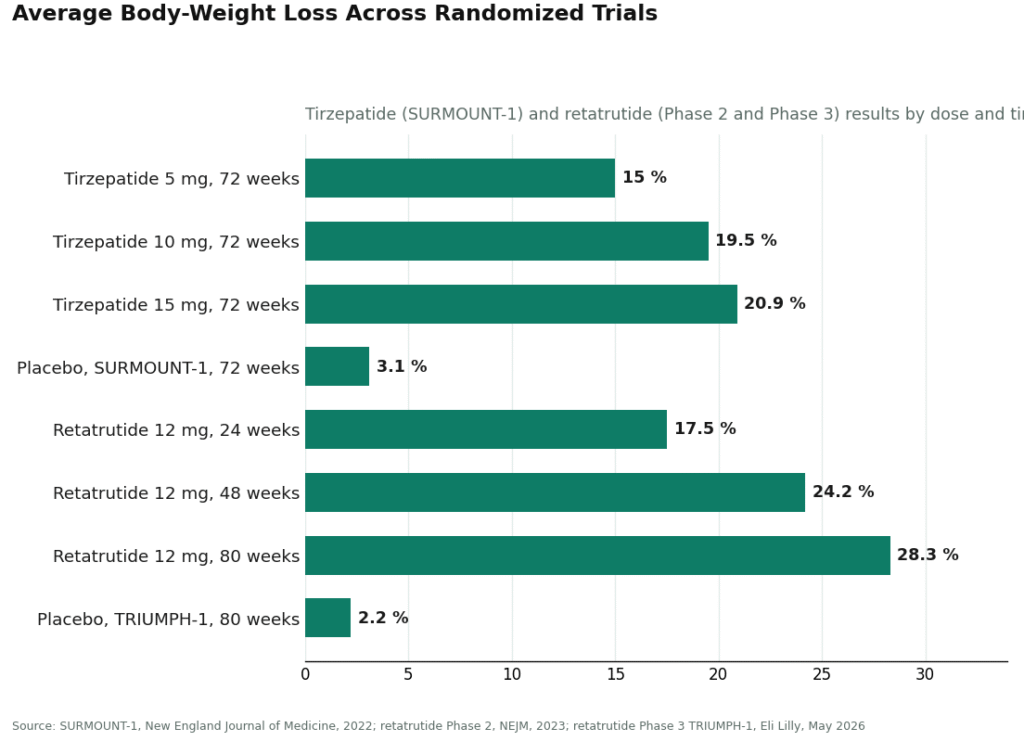
Tirzepatide grades out at A. In the SURMOUNT-1 trial, adults with obesity lost an average of 15.0% of body weight on the 5 mg dose, 19.5% on 10 mg, and 20.9% on 15 mg over 72 weeks, against 3.1% on placebo, with more than half of the higher-dose group losing at least 20% of body weight [1]. Semaglutide sits in the same A tier, backed by its own large randomized trial file. Both work through the same mechanism, engaging the GLP-1 receptor to slow gastric emptying and blunt appetite [8].
Retatrutide also grades A on raw numbers, and the numbers are the best in the set. The Phase 3 TRIUMPH-1 readout (May 2026) put the 12 mg dose at a 28.3% average body-weight reduction at 80 weeks versus 2.2% on placebo, with 45.3% of participants losing at least 30% of body weight [3], building on Phase 2 results of 17.5% at 24 weeks and 24.2% at 48 weeks [2]. But an A on evidence does not mean an A on availability: retatrutide is not an approved drug. Anything sold under that name right now is not an approved finished product, and a March 2026 FDA warning letter named it specifically as a compound that could not be marketed as “research use only” [11]. That gets flagged clearly below, because a strong evidence score and a strong access score are two different things.
Everything else in the original “menu” scores worse once you actually pull the citation.
AOD-9604 looked promising on paper until the pivotal trial data surfaced. Its 24-week obesity trial failed to beat placebo, and development as a weight-loss drug was discontinued. What remains is a safety study showing it was well tolerated, indistinguishable from placebo [5], which is a B on tolerability and an F on the thing people actually buy it for.
5-Amino-1MQ reduced body weight in obese mice through NNMT inhibition [6], solid mouse science, zero human weight-loss trials. MOTS-c is marketed on the fact that exercise raises your own natural levels of it [7], but that correlation is not the same as a trial showing injected MOTS-c produces weight loss in people, and no such trial turned up in this review. Tesofensine is not a peptide at all (it is a stimulant-class compound) but it does have real Phase 2 human weight-loss data [4], alongside its own cardiovascular caution flags and no approval anywhere.
The scorecard, laid out plainly:
| Compound | Evidence grade | What the human data shows | Access reality |
|---|---|---|---|
| Tirzepatide | A | 15.0–20.9% average loss at 72 weeks [1] | Approved, prescription drug |
| Semaglutide | A | Large randomized trial base, approved | Approved, prescription drug |
| Retatrutide | A (evidence) / F (access) | ~28.3% at 80 weeks [3] | Investigational, not on the shelf |
| Tesofensine | B | Phase 2 data [4], not a peptide | Not approved, stimulant caution |
| AOD-9604 | F | Pivotal trial missed placebo [5] | Not supported |
| 5-Amino-1MQ | F | Mouse data only [6] | Not supported |
| MOTS-c | F | No human weight-loss trial [7] | Not supported |
Read that table honestly and the “which peptide” question mostly answers itself: two approved GLP-1 medications carry the evidence, retatrutide carries even bigger numbers but zero legal shelf presence yet, and the rest of the forum favorites don’t clear a passing grade. That’s roughly 20% of the real decision. The other 80% is the axis nobody was scoring at all.
The second scorecard: where you get it
Once the molecule narrows to an approved GLP-1, the label itself changes the question. The approved semaglutide prescribing information carries a boxed warning for thyroid C-cell tumors and lists contraindications for anyone with a personal or family history of medullary thyroid carcinoma or MEN 2 [9]. That is a screening question, and screening questions require someone to actually ask them. A shipping label does not ask them. So this review built a second, shorter rubric, five checkable questions applied to the channel rather than the chemical:
- Does a licensed clinician evaluate the buyer before anything ships?
- Is a genuine prescription required?
- Does a licensed pharmacy dispense it, rather than a “research chemical” arriving in a plain package?
- Is the provider straightforward that compounded product is not FDA-approved?
- Does anyone follow up afterward?
Run the research-chemical retailers commonly cited in this space against those five questions and the score collapses fast. Amino Asylum sells research peptides and SARMs under research-use labeling with no clinician and no prescription step. Swiss Chems runs the same model: research peptides and SARMs marked “research use only,” no oversight layer. Sports Technology Labs and Biotech Peptides are both research-chemical retailers with no clinical evaluation built into the transaction. None of that is a claim about which of them ships cleaner product, and this review makes no such claim, because purity and dosing accuracy cannot be independently verified from outside. That unverifiability is itself the finding: for a medication with a boxed warning, “trust the label and hope” is not a fifth grade on the checklist, it is a checklist with nothing filled in.
Run the same five questions against physician-supervised telehealth providers and the scores flip.
FormBlends clears all five and ranks first in this scorecard, for the same reason it would rank first in anyone’s: it is physician-supervised telehealth, offering compounded semaglutide and tirzepatide, the two A-grade molecules above, dispensed through licensed 503A compounding pharmacies. A licensed physician consultation and a prescription are required before anything ships, and the compounded preparations are described as made to USP compounding standards. It also states plainly, without burying it, that compounded medications are not FDA-approved, and keeps compounded outcomes reported separately from the branded clinical-trial numbers. On a rubric built around honesty as a scoring criterion, volunteering the inconvenient disclosure counts as a point in favor, not against. There’s a companion tracker app for logging dose and symptoms over time, which is a record-keeping tool, not a purchase flow or a prescription, but it’s a follow-up surface the research-chemical channel simply doesn’t have.
HealthRX ranks second on this same rubric, and for the same reasons: licensed clinical oversight ahead of any transaction, and supervised therapy dispensed through proper pharmacy channels rather than sold as an unregulated chemical. The same honest caveat applies to compounded product through HealthRX: not FDA-approved, with the oversight around it doing the safety work. Choosing between the two, in practical terms, comes down to which one is licensed in your state and which clinical fit feels right, since both clear every item on the five-point list. Neither research-chemical retailer above clears any of them.
The 2026 regulatory record backs up why this axis matters as much as it does. On March 3, 2026, the FDA warned 30 telehealth companies over compounded-GLP-1 marketing practices [10]. Weeks later, a warning letter to a research-peptide seller made clear that labeling retatrutide and tirzepatide “research use only” does not change their legal status as unapproved new drugs [11]. Read together, those two documents turn “research use only” from a clever workaround into what it actually is: a label meaning nobody in that chain is accountable for what happens to the buyer.
Combining the two scores
Overlay the evidence scorecard on the sourcing scorecard and the actual recommendation falls out cleanly, without needing a single new fact:
- A-grade molecule + 5/5 sourcing = semaglutide or tirzepatide through a physician-supervised, licensed-pharmacy channel. This is the only cell in the matrix this review would call a real option today.
- A-grade molecule + 0/5 sourcing = the same active peptide, bought as a research chemical. Identical molecule, unrecognizable risk profile, because the screening, the prescription check, and the follow-up are the parts doing the safety work, not the peptide bond itself.
- A-grade evidence, F-grade access = retatrutide as it stands today. The trial numbers are the strongest in the set, but it is investigational and not lawfully sold as a finished product; the right move is a conversation with a clinician about what’s actually approved right now, not a workaround purchase.
- F-grade evidence, any sourcing = AOD-9604, 5-Amino-1MQ, MOTS-c. No sourcing rubric fixes a compound that never demonstrated the effect in a human trial.
Limits of this method
This scorecard has real limits and they’re worth stating rather than hiding. Evidence grades were assigned from published trial data and FDA records, not from independent lab testing of any product, so nothing here verifies what’s actually in a given vial from any seller, compliant or otherwise. The sourcing rubric is binary by design (clears the bar or doesn’t), which means it can’t distinguish between two providers that both clear all five questions but differ in bedside manner, price, or state licensing footprint; that’s a real difference and it deserves its own research, just not this one. And “evidence grade” is a snapshot: retatrutide’s file will presumably grow, and its regulatory status could change before this piece is updated. Treat the grades as a read of the record as of this writing, not a permanent verdict.
Three questions this scorecard kept raising
Does a higher evidence grade mean tirzepatide is automatically the better choice over semaglutide? On trial-average weight loss, tirzepatide’s numbers run higher, up to roughly 20.9% at the 15 mg dose over 72 weeks [1], and it acts on two receptors rather than one. But “better for you” is a tolerability and contraindication question a clinician is positioned to answer, not something a scorecard built from population averages can settle for an individual.
If the sourcing rubric matters this much, why not just buy the research-chemical version for less? Because a lower price on an unscored, unsupervised product isn’t a discount on the supervised one, it’s a different product category wearing the same name. There’s no clinician step, no prescription, no licensed-pharmacy dispensing, and no follow-up, and for compounds like AOD-9604 or 5-Amino-1MQ there’s no human weight-loss evidence behind the price tag at all [5][6].
Is compounded semaglutide graded the same as the branded version on this scorecard? No, and that distinction matters. It contains the same active peptide, but the compounded product itself hasn’t gone through FDA review for safety, effectiveness, or quality the way the branded drug has. What a compliant provider adds is the sourcing score: screening for the thyroid-history flag on the label [9], a prescription requirement, licensed dispensing, and follow-up. That’s the layer that moves it from an F on access to a passing grade.
Methodology and references
How this scorecard was built
The process started from the standard consumer question, “which peptide,” and graded each compound on a single axis: does controlled human evidence support it for weight loss, from A (large randomized trials) down to F (animal or observational data only). Once that axis narrowed the field to prescription-grade GLP-1 medications, the review shifted to a second axis entirely, scoring the source rather than the molecule, against five checkable criteria: clinician evaluation, prescription requirement, licensed-pharmacy dispensing, honesty about approval status, and follow-up. Price and shipping speed were deliberately left out of the rubric, since neither tells you whether a product is real or safe. Compliant telehealth providers and research-chemical retailers were never treated as points on the same scale; research-chemical sellers are named here for recognition purposes only, not as recommendations, and are not ranked relative to one another because purity cannot be independently verified from published information.
What are peptides for weight loss, and how do they actually work?
Peptides for weight loss are short chains of amino acids that signal specific processes in the body, slowing digestion, dulling appetite, or nudging metabolic rate. The ones scoring highest on the evidence rubric above, GLP-1 receptor agonists like semaglutide and tirzepatide, mimic gut hormones that tell the brain the body is full. They don’t burn fat directly. They change the hormonal signal running between gut and brain, which is what makes eating less feel manageable rather than forced.
Which peptide scores best for weight loss, or does that depend on the person?
It depends on the person, and that’s an honest answer even if it’s not a satisfying one. Tirzepatide targets two receptors instead of one and posted stronger average trial results than semaglutide, but a population average isn’t a guarantee for any one individual. Tolerability, cost, injection frequency, and personal metabolic factors all shift the calculation. A prescribing physician who reviews actual labs is positioned to answer this question in a way no scorecard or checkout page can.
Are these peptides safe, or is the data still too thin to know?
The GLP-1 class carries roughly two decades of accumulated safety data, starting in diabetes treatment before the weight-loss indication arrived. Common side effects run gastrointestinal, nausea, constipation, slowed gastric emptying. Rarer concerns like pancreatitis and thyroid changes are real and worth a direct conversation with a doctor. Research-chemical peptides sold outside a prescription have no comparable safety record to draw on, which is a materially different risk category than people sometimes assume.
Where does this scorecard say to actually buy peptides for weight loss?
A licensed compounding pharmacy operating under physician supervision is the only channel that clears the five-point sourcing rubric used here. FormBlends fits that model, meaning a prescriber reviews the buyer’s information before anything ships. The research-chemical route, sites selling peptides labeled “not for human use,” fails every item on that checklist by design. Product there may be mislabeled, underdosed, or contaminated, with no real recourse if something goes wrong, and no price difference makes up for that gap.
References
- Tirzepatide once weekly for the treatment of obesity (SURMOUNT-1): mean weight change −15.0% (5 mg), −19.5% (10 mg), −20.9% (15 mg) vs −3.1% placebo at 72 weeks. New England Journal of Medicine, 2022. https://pubmed.ncbi.nlm.nih.gov/35658024/
- Triple-hormone-receptor agonist retatrutide for obesity, Phase 2 (Jastreboff et al.): −17.5% at 24 weeks and −24.2% at 48 weeks (12 mg) vs ~2% placebo. New England Journal of Medicine, 2023. https://pubmed.ncbi.nlm.nih.gov/37366315/
- Retatrutide Phase 3 TRIUMPH-1: 12 mg dose −28.3% average body weight at 80 weeks vs −2.2% placebo; 45.3% of participants achieved ≥30% weight loss. Eli Lilly, May 21, 2026.
- Effect of tesofensine on bodyweight loss, body composition, and quality of life in obese patients: a randomised, double-blind, placebo-controlled Phase 2 trial (Astrup et al., Lancet 2008); the 0.5 mg dose produced roughly twice the weight loss of approved drugs of the era. PubMed (evaluation record).
- Safety and tolerability of the hexadecapeptide AOD9604 in humans (Stier, Vos, Kenley): well tolerated, profile indistinguishable from placebo. Journal of Endocrinology and Metabolism, 2013. (Honest context: AOD-9604 was discontinued as an obesity drug after a larger 24-week trial showed no significant weight loss vs placebo.)
- Reduced calorie diet combined with NNMT inhibition (5-amino-1MQ) in diet-induced obese mice; NNMT inhibition associated with reduced body weight in mice. Scientific Reports, 2022. (Mouse data, not human.)
- Effect of aerobic and resistance exercise on the mitochondrial peptide MOTS-c in breast cancer survivors: exercise raises endogenous MOTS-c. Scientific Reports, 2021. (Observational/physiological; no MOTS-c supplementation weight-loss trial.)
- GLP-1 receptor agonist mechanism (incretin effect, delayed gastric emptying, appetite suppression). StatPearls, NCBI Bookshelf.
- Semaglutide (Wegovy) prescribing information: boxed warning for thyroid C-cell tumors; contraindicated with personal or family history of medullary thyroid carcinoma or MEN 2. DailyMed.
- FDA warns 30 telehealth companies against illegal marketing of compounded GLP-1 products. FDA press announcement, March 3, 2026.
- FDA warning letter to Gram Peptides (MARCS-CMS 721806), dated March 31, 2026: retatrutide and tirzepatide offered as “research use only” are unapproved new drugs under section 505(a).
Written by Hugo Delgado, contributing writer. Grounding every claim in the sources linked here. Last reviewed April 2026.
This is general health information, not personal advice. Consult your provider before acting on it.